Same Ammo, Different Gun, Completely Different Results: Understanding Firearm-Ammo Compatibility
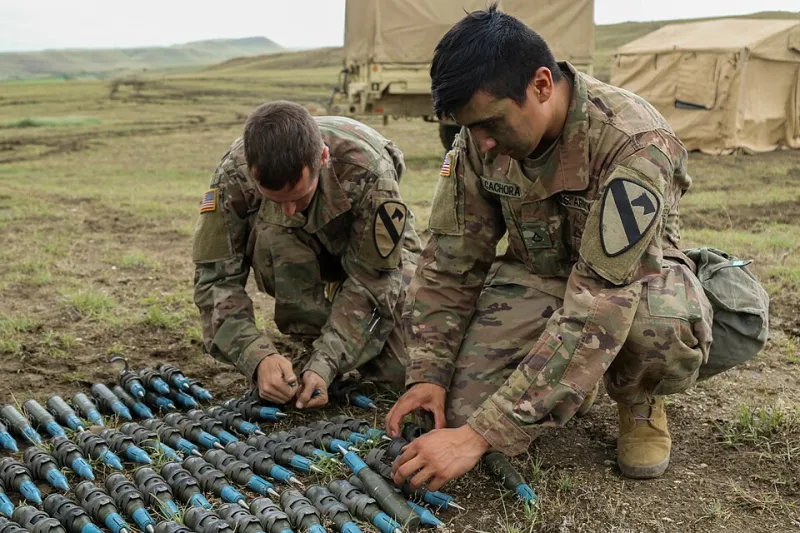
Photo: U.S. Army photo by Sgt. Kris Bonet, Public domain, via Wikimedia Commons
Here's a scenario that plays out at ranges across the country every weekend. Two buddies show up with the same rifle — same manufacturer, same model, same year — and the same box of ammunition. One shooter is punching tight groups. The other is chasing fliers all over the target. They swap guns. The results mostly swap with them.
This isn't a mystery. It's physics, manufacturing tolerance, and the basic reality that no two firearms are truly identical — even when they share a name on the side of the receiver. Understanding why ammunition performs differently across guns, and what to do about it, is one of the most practical skills a shooter can develop.
Manufacturing Tolerances: The Hidden Variable
Firearms are manufactured to specifications — but specifications define a range, not a single exact value. Chamber dimensions, bore diameter, throat length, and headspace are all controlled to tolerances that allow for efficient production. Within those tolerances, guns that are technically "the same" can vary in ways that meaningfully affect how ammunition performs.
Consider chamber throat length — the freebore between the end of the chamber and where the rifling begins. A longer throat gives a bullet more distance to travel before engaging the rifling. A shorter throat means the bullet is closer to the lands when the round is chambered. This affects pressure curve, velocity, and how the bullet enters the rifling — all of which influence accuracy.
Two rifles from the same production run can have throat lengths that vary by a few thousandths of an inch. That sounds trivial. For a casual shooter at 50 yards, it is. For a precision shooter at 500 yards, or a hunter taking a long shot on an elk, those thousandths start to matter.
Barrel Twist Rate: Why Bullet Weight Isn't Optional
Every rifled barrel has a twist rate — the rate at which the rifling causes the bullet to rotate. It's expressed as a ratio, like 1:10 (one full rotation per 10 inches of barrel) or 1:8 (one rotation per 8 inches, a faster twist).
Different bullet weights and lengths require different twist rates to stabilize properly. A fast twist rate like 1:7 is designed for longer, heavier bullets — it spins them fast enough to maintain stable flight. A slower twist like 1:12 is optimized for shorter, lighter bullets.
Here's where compatibility gets real: push an underpowered spin rate on a long, heavy bullet and you get keyholing — the bullet tumbles in flight and hits the target sideways. Push an overpowered spin rate on a light bullet and you can actually over-stabilize it, reducing accuracy and in some cases causing the bullet to come apart from centrifugal force at high velocities.
The AR-15 platform is a perfect case study. Early 1:12 twist barrels were designed around the original 55-grain M193 projectile. Modern barrels in 1:7 or 1:8 are optimized for heavier 62- to 77-grain projectiles. Run 77-grain match ammo through an old 1:12 barrel and you'll likely see poor results — not because the ammo is bad, but because the barrel can't stabilize it.
Always know your barrel's twist rate before selecting ammunition, especially if you're pushing the weight range in either direction.
Chamber Dimensions and Cartridge Spec Variations
This is where the conversation gets genuinely important for safety, not just performance.
The .223 Remington and 5.56x45mm NATO situation is the most widely discussed example. Both cartridges are nearly identical dimensionally, but 5.56 NATO operates at higher pressures and has a longer throat (freebore). A .223 Remington chamber has a shorter throat and tighter specifications. Running 5.56 NATO ammo in a .223 Remington chamber can generate pressure spikes that exceed safe limits over time — not necessarily catastrophic on a single round, but cumulative wear that can shorten barrel life or, in extreme cases, cause failure.
A 5.56 NATO chamber, by contrast, handles both cartridges safely. This is why most modern AR-15s are chambered in 5.56 NATO rather than strict .223 Remington.
Similar dynamics exist with .308 Winchester and 7.62x51mm NATO, as well as with various pistol chamberings. The takeaway: chamber specification matters, and it's not always obvious from the caliber designation alone.
Bore Diameter and Bullet Diameter: A Tighter Relationship Than You'd Think
Nominal bore diameters vary between manufacturers and even between production runs from the same manufacturer. A .308 bullet is nominally .308 inches in diameter, but bore dimensions can vary by a few ten-thousandths of an inch across production.
A barrel with a slightly tighter bore will generate higher pressure with a given load than a barrel with a slightly looser bore. This affects velocity, of course, but it also affects how the bullet engages the rifling and how consistently it does so shot to shot — which directly impacts group size.
This is one reason why handloaders working up precision loads for a specific rifle measure their actual bore diameter with specialized tools rather than assuming nominal values. For factory ammo shooters, it's less actionable — but it explains why some loads just seem to "like" certain guns and not others.
Case Studies in Unexpected Incompatibility
The suppressor scenario: A shooter runs a specific subsonic 300 Blackout load reliably in an unsuppressed rifle. Add a suppressor — which increases backpressure — and the same load starts cycling inconsistently. The ammo didn't change; the system dynamics did.
The 1911 feeding issue: A shooter runs one brand of 230-grain FMJ flawlessly through their 1911. Switches to a different brand with a slightly different ogive profile and experiences repeated failures to feed. Both rounds are within spec. The feed ramp geometry in that specific pistol simply prefers one profile over the other.
The lever-gun headache: A shooter buys a popular .357 Magnum lever-action and runs the same ammo a friend uses in his revolver. The lever gun shows inconsistent ignition with one primer brand that the revolver never has trouble with. The firing pin strike geometry differs enough between the two platforms that primer sensitivity becomes a factor.
None of these are manufacturer defects. They're compatibility realities.
Building Your Own Compatibility Testing Framework
The only way to truly know what works in your specific gun is to test it yourself. Here's a practical approach:
Start with a baseline. Pick a load you know is within spec for your firearm and establish a baseline group at your typical shooting distance. Chronograph it if possible.
Test systematically, not randomly. Change one variable at a time — bullet weight, bullet construction, or brand. Running three or four different loads in the same session gives you directly comparable data.
Shoot enough rounds to see patterns. Five-round groups tell you something. Three-group averages tell you much more. Anomalies in small samples are common; consistent patterns across multiple groups are meaningful.
Document everything. Temperature, distance, rest type, and any mechanical variables. What works on a 70°F afternoon might behave differently on a 30°F morning hunt.
Don't assume your friend's results apply to you. Their gun, even if it's the same model, is not your gun. Their data is a useful starting point, not a conclusion.
The ammunition that performs brilliantly in a buddy's rifle might be mediocre in yours — and the load that everyone dismisses online might turn out to be exactly what your specific barrel wants. The only way to know is to run the test yourself.