Your Ammo Isn't the Problem: The Honest Truth About Why Your Shots Are Missing

It's a story every range regular has heard — or lived. A shooter is throwing flyers, groups are opening up, and the immediate conclusion is that the ammunition must be garbage. Next thing you know, they're dropping twice the money on match-grade rounds expecting a transformation. Then the groups stay wide, the frustration doubles, and the expensive ammo gets blamed for something else entirely.
Here's the hard truth: in the vast majority of cases, the ammunition isn't your problem. You are.
That's not an insult — it's actually good news. Because fixing your technique costs a lot less than chasing premium ammo forever.
The Accuracy Blame Game
Shooters love to blame their gear. It's human nature. Blaming the ammo feels a lot better than accepting that your trigger pull is inconsistent or your grip is torquing the gun at the moment of firing. But ammunition quality, for most practical shooting purposes, is rarely the limiting factor.
Consider this: a trained competitive shooter handed a box of cheap bulk .223 will consistently outshoot an untrained shooter using hand-loaded match-grade rounds. The skill gap between shooters is almost always larger than the performance gap between ammunition tiers. This doesn't mean ammo quality doesn't matter — it absolutely does at certain levels — but it means that investing in your fundamentals first is always the smarter play.
The Four Fundamentals That Actually Control Your Groups
If you want to improve your accuracy, start here. These are the mechanics that have the highest impact on where your rounds land.
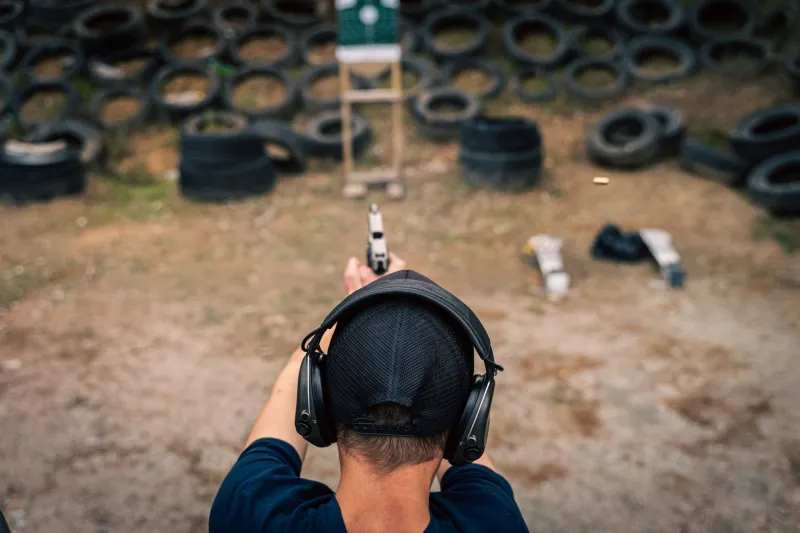
Trigger Control This one accounts for more accuracy problems than any other single factor. The moment you anticipate recoil and flinch — even slightly — you're moving the muzzle before the bullet exits. That tiny movement translates to significant deviation downrange. Dry fire practice is the fastest, cheapest fix available. Spend 15 minutes a night working on a smooth, consistent trigger press and you'll see results faster than any ammo upgrade could deliver.
Grip Consistency An inconsistent grip means inconsistent recoil management, which means inconsistent shot placement. Your firing hand should apply the same pressure every single time. Your support hand should be doing actual work — not just resting there. High thumbs-forward grip for semi-autos, firm two-handed control for revolvers. The gun should move the same way on every shot.
Natural Point of Aim This is something newer shooters almost never think about. If your body isn't naturally aligned with your target, you're muscling the gun into position — and muscles fatigue and shift. Get your stance right, align your body toward the target, and let the gun settle naturally. This matters enormously for sustained accuracy during longer shooting sessions.
Follow-Through Most shooters mentally check out the moment the trigger breaks. They drop the gun, look for the hit, and lose their position. Real follow-through means staying on the sights through the entire firing sequence. It keeps everything aligned and reinforces good habits over time.
So When Does Better Ammo Actually Help?
This isn't a case against quality ammunition — we're a store that takes ammo seriously, after all. There absolutely are scenarios where upgrading your rounds makes a meaningful difference.
Once your fundamentals are dialed in and you're consistently producing tight groups, ammunition consistency becomes the next ceiling. If you're shooting groups under 1 MOA and trying to squeeze out sub-half-MOA performance, the variation in factory ammunition velocity and bullet weight can matter. At that level, you've outshot the ammo.
For competition shooters working in precision rifle or long-range disciplines, consistent velocity — measured by standard deviation and extreme spread — genuinely impacts performance at distance. We'll talk more about those metrics in a separate piece, but the point is that these details only become relevant once your mechanics are already excellent.
For hunters, the calculus is different. A quality hunting round with controlled expansion and reliable terminal performance matters from an ethical standpoint, but that's about bullet construction and caliber selection — not about chasing the tightest possible groups. A deer at 80 yards doesn't care if your ammo produces 0.75 MOA versus 1.1 MOA. It cares whether you held steady and squeezed the trigger correctly.
The Cheap Fix Most Shooters Skip
If you want the fastest accuracy improvement available, it doesn't come from a new box of ammo. It comes from a few things that cost almost nothing:
- Dry fire practice — 10 to 15 minutes daily does more for your trigger control than a hundred rounds of live fire without intention
- Video feedback — film yourself shooting. You'll see your flinch, your grip shift, your stance problems immediately
- Slow fire drills — slow everything down and focus on one fundamental at a time. Speed is a byproduct of perfected mechanics, not the other way around
- A qualified instructor — even a single session with a competent instructor can identify issues you've been reinforcing for years
The Honest Upgrade Path
Here's a framework for thinking about when to invest in better ammo versus when to invest in yourself:
If your groups are inconsistent and large — work on fundamentals. Don't buy better ammo yet.
If your groups are consistent but larger than you'd like — check your fundamentals and your barrel condition. Still probably not an ammo issue.
If your groups are consistently tight but you're hitting a performance ceiling — now it's worth exploring premium ammunition, better components, or reloading for your specific application.
The bottom line is that premium ammunition performs best when it's in the hands of a shooter who has already done the foundational work. Spend the time, put in the dry fire reps, get some instruction if you can, and then — once you've genuinely maxed out your mechanics — come back and explore what the right ammo can do for you. That's when the upgrade actually means something.